The Scottish Law Commission was asked by the Scottish Government in 2022 to review the law of the tenement in Scotland and make recommendations on the introduction of compulsory owners’ associations for all tenement buildings. Their detailed report on this recommendation, which is aimed at improving how shared property is managed, maintained and repaired, has been published this month.
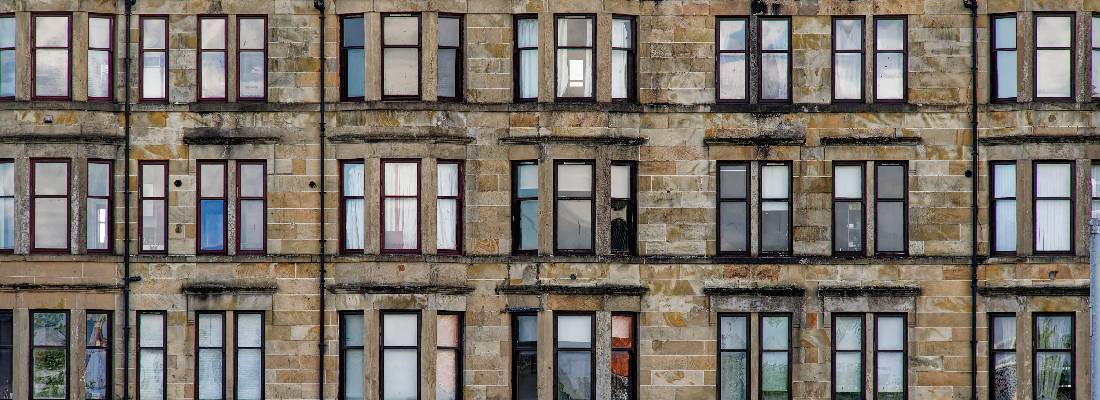
Tenements remain a dominant form of housing in Scotland, encompassing traditional sandstone buildings, post war developments and modern apartment blocks. While many function well, a significant number experience long standing problems linked to the maintenance of shared parts, including: roofs, external walls, stairwells and drainage systems. The Scottish Law Commission’s proposals seek to address structural weaknesses in the current legal framework that can make collective decision making difficult and, in some cases, ineffective.
The current position
At present, owners’ associations in tenements are typically informal and voluntary. While some title deeds provide management arrangements, many are outdated, incomplete or unclear. Where no effective structure exists, decisions about repairs and maintenance can be delayed or prevented altogether due to lack of agreement, difficulty contacting owners, or uncertainty about legal authority.
Existing legislation, including the Scottish Tenements Act 2004, provides mechanisms for decision making but these can still be challenging to operate in practice. The absence of a single, legally recognised body for each tenement often results in fragmented responsibility, poor communication and difficulties in enforcing decisions or collecting funds.
The proposal for compulsory owners’ associations
The Scottish Law Commission recommends that every tenement should automatically have an owners’ association created by law on a designated date. This would remove the voluntary nature of associations and ensure a consistent structure across Scotland’s tenement housing stock.
Under the proposals, each owners’ association would have legal personality. This means the association could act in its own name, separate from individual owners. It would be able to hold funds, enter contracts, instruct professionals and take legal action if required. This represents a significant shift from the current position, where such actions often depend on individual owners acting jointly.
Core responsibilities and requirements
The draft legislation sets out several basic requirements for owners’ associations. These include:
- Responsibility for the management and maintenance of shared parts of the building
- The appointment of a manager or property factor
- The holding of annual general meetings
- The preparation and approval of an annual budget
- The maintenance of key information about the building, ownership and management arrangements
- These requirements are intended to provide a minimum standard of governance while allowing flexibility in how individual tenements operate.
- Management and professional involvement
A key aspect of the proposals is the expectation that owners’ associations would appoint a manager or property factor. While not prescribing how management must be delivered, the Commission recognises that professional management is often necessary to ensure compliance with legal obligations, coordination of repairs and financial administration.
The proposals do not remove the role of property factors; rather, they formalise and clarify the relationship between owners, associations and managing agents. This is intended to improve transparency, accountability and consistency across the sector.
Financial planning and long-term maintenance
One of the underlying concerns addressed by the report is the lack of forward planning for building maintenance. Many tenements rely on reactive repairs rather than planned maintenance, which can lead to higher costs and greater disruption over time.
By requiring owners’ associations to set budgets and manage funds collectively, the proposals aim to encourage a more proactive approach. While the report focuses primarily on governance structures, it sits alongside wider policy discussions about building inspections, reserve funds and long-term maintenance planning.
Benefits and limitations
Supporters of the proposals argue that compulsory owners’ associations would make it easier to organise repairs, improve building standards and protect the long-term condition of Scotland’s tenement housing. A clear legal structure could reduce disputes, simplify decision-making and ensure that responsibility for shared property is properly allocated.
However, commentators have also noted that compulsory associations are not a complete solution. Effective outcomes will still depend on engagement from owners, realistic financial planning and access to professional expertise. The proposals provide a framework, but their success would rely on how they are implemented and supported in practice.
Wider context
The report reflects growing concern about the condition of Scotland’s built environment, particularly in urban areas with large numbers of older tenements. Issues such as climate resilience, building safety and sustainability have increased the importance of effective collective management.
The proposals are also aligned with broader efforts to modernise property law and ensure that legal structures reflect contemporary housing realities, including mixed tenure buildings and absentee ownership.
What happens next?
The Scottish Law Commission’s recommendations are not law at this stage. The report and draft Bill have been submitted to the Scottish Government, which will decide whether to introduce legislation based on the proposals.
If taken forward, the reforms would represent one of the most significant changes to tenement management in Scotland in recent decades. Transitional arrangements and further guidance would be required to support implementation and ensure that owners, managers and professionals understand their responsibilities.
The full report can be read here